
Findings: European Business Equipment Outlook 2026

What does this mean for UK businesses
Equipment is going out of date faster, capital is under pressure and the end of an asset’s life is getting harder to manage. These are three of the clearest findings from the European Business Equipment Outlook 2026, our study of how businesses fund, use and retire equipment.
Censuswide carried out the research in December 2025. It gathered the views of more than 1,000 C-suite and senior decision-makers across 11 European markets, including the UK. Respondents work in equipment-intensive sectors such as agriculture, construction, transport and logistics, technology, healthcare and clean energy.
This article sets out the main findings and what they mean for UK businesses planning investment for 2027.
Equipment is going out of date faster
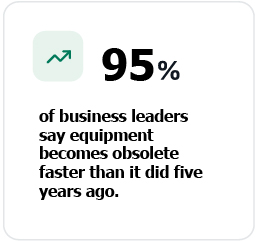
For many, equipment now ages before it pays for itself. Almost all business leaders (95%) say equipment becomes obsolete faster than it did five years ago.
Almost all business leaders (95%) say equipment becomes obsolete faster than it did five years ago. Most put the speed-up at between 25% and 50%.
Uncertainty about future technology is delaying capital expenditure plans for 64% of businesses, while 21% describe those delays as significant or severe. Healthcare is the most affected sector, with 31% reporting significant or severe delays.
Capital tied up in owned equipment
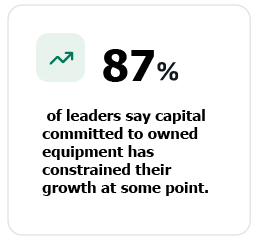
More than eight in ten leaders (87%) say capital committed to owned equipment has constrained growth at some point. Over a third (35%) say this happens frequently or very frequently.
We asked where they would invest if that capital were released. Sustainability, energy efficiency and green technology came top at 33%, followed by market expansion (32%), digital transformation (32%) and R&D (31%).
Managing equipment at the end of its life
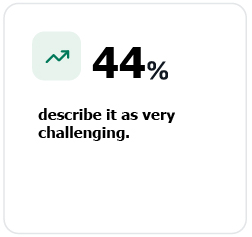
Responsibility for equipment now runs well beyond the purchase. Managing the end of life of owned equipment is challenging for 87% of organisations, with 44% describing it as very challenging.
That difficulty is shaping what businesses buy. The ease of refurbishment, reuse, recycling and disposal influences purchasing decisions for 68% of organisations. In the technology sector, the figure rises to 73%.
UK businesses already work within this link. Under the WEEE rules, the producer of business electrical equipment usually funds its collection and recycling, unless the producer and the business user agree a different arrangement.
How businesses are using leasing and usage-based models
Ownership remains the most common route. 4Outright ownership remains the primary funding route for 41% of organisations, while 63% say ownership is important to their competitiveness.
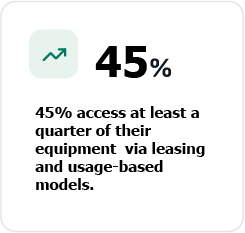
Leasing and usage-based models are already well established alongside it. Almost half (45%) access at least a quarter of their equipment through leasing or usage-based models. Greater access to these models would make businesses more agile according to 58% of respondents, rising to 62% in the UK.
Barriers remain. The most common are a preference for ownership and control (31%), a lack of supplier options (31%), perceived higher cost over time (29%) and uncertainty about end-of-contract processes (28%).
What this means for UK businesses
UK firms are planning 2027 investment with Bank Rate at 3.75%, after the Bank of England held rates in September. The Autumn Budget follows on 28 October.
Demand for equipment finance is holding up. Finance & Leasing Association figures show asset finance new business up 6% in the first seven months of 2026, with SME lending at a record £25.6bn over the past year.
The findings point to businesses choosing the funding route asset by asset. Ownership continues to suit long-lived assets with predictable use. Where technology changes quickly, models that agree return conditions at the outset can make it easier to adapt.
As Neil Pein, CEO of BNP Paribas Leasing Solutions, writes in the report’s foreword: “Many organisations are now navigating this tension. They are balancing the need to keep control with the need to stay agile.”
Read the full report
The European Business Equipment Outlook 2026 covers these findings in full, with breakdowns by country and sector. Read it at leasingsolutions.bnpparibas.co.uk